Showing posts with label progressive. Show all posts

Saturday, July 30, 2011

New Poll On New York Marriage Law


There is a new poll which asks Americans nationwide whether the legalization of marriage equality in New York state on July 24th is a positive or negative development. The results show that it depends on whether you are conservative Republican (and/or white evangelical Protestant) or not. If you are, you generally oppose it, if you're not you think it's a positive development.
Democrats and Republicans react in opposite ways to the new law, each facing stark internal divisions that may present challenges to building a winning coalition in 2012. Among Democrats, the divide is between the liberal base and those with conservative or moderate stripes. Liberal Democrats view the law positively by an overwhelming 74 to 25 percent margin. A smaller 54 percent majority of moderate and conservative Democrats say the same. Among African Americans, another loyal segment of the Democratic party coalition, more than six in 10 say the law is a negative development, while roughly one in three see it positively. Republicans broadly reject the law by a 2 to 1 margin, but alignment with the tea party movement complicates political calculations concerning the issue. More than seven in 10 Republicans who support the Tea Party movement view the New York law as a negative development.
This partisan divide in the electorate about marriage equality has been a frequent topic at this blog. Many people believe that the tipping point in favor of marriage equality becoming the law of the land has already reached.

Recently, researches at my alma mater have produced a model of conversion which indicates that when just 10% of a population has an implacable, unalterable position that view will eventually become the majority position, given enough time.

Wednesday, July 27, 2011

Brown Nominates Goodwin Liu To CA Sup Ct!

Charles Dharapak / AP Photo
Goodwin Liu, 40, was rejected by a Republican United States Senate filibuster for a coveted position on the 9th U.S. Circuit Court of Appeals but has received a pretty nice consolation prize: a nomination by Governor Jerry Brown to the California State Supreme Court (from which he could still be nominated to the U.S. Supreme Court before he's 50).

The Los Angeles Times reports:
Liu, a graduate of Yale Law School, is the son of Taiwanese immigrants. He was born in Georgia, grew up in Sacramento and has a history of public service.
“I’m deeply honored by Gov. Brown’s nomination and look forward to the opportunity to serve the people of California on our state’s highest court,” Liu said in a statement.
Before joining the Berkeley Law faculty in 2003, Liu was an appellate litigator at O'Melveny & Myers in Washington. He clerked for U.S. Supreme Court Justice Ruth Bader Ginsburg and for Judge David Tatel of the U.S. Court of Appeals for the D.C. Circuit. He also served as special assistant to the deputy secretary of the U.S. Department of Education and as senior program officer for higher education at the Corporation for National Service (AmeriCorps).
Brown has forwarded Liu’s name to the State Bar’s Commission of Judicial Nominees Evaluation. The appointment will not become final until the Commission on Judicial Appointments -- consisting of state Supreme Court Chief Justice Tani Cantil-Sakauye, Atty. Gen. Kamala Harris and Justice Joan Dempsey Klein, senior presiding justice of the state Court of Appeal -- confirms the nomination.

Liu will replace Associate Justice Carlos Moreno, who retired from the court earlier this year.
Justice Moreno was a very strong advocate for the LGBT community, voting with 4-3 majority to end marriage discrimination in California's landmark In Re Marriage cases in 2008 and was the lone dissenter in 2009's California Supreme Court decision which upheld Proposition 8 as not violating the California constitution.

Goodwin Liu has previously expressed his belief that Proposition 8 is unconstitutional so it will be interesting to see if he can get confirmed in time to participate in the case now before the case as to whether the heterosexual supremacist supporters of Proposition 8 have legal standing to defend it in court when the elected representatives of the people of California have decided not to defend a voter-approved ballot measure.

Another interesting feature that Liu, if confirmed will produce a court with an Asian American majority and no Black or Latino members, in a state which has Latino plurality in the population. Things that make you go Hmmmmmm! That being said, Liu is a great choice, since he can't get through the Senate to a federal judgeship while Republicans have more than 40 votes and no compunctions about filibustering extremely qualified judges purely based on ideology, a state supreme court seat is fantastic.

Friday, July 22, 2011

Celebrity Friday: Luis Lopez, Latino LGBT candidate for AD-45

Luis Lopez is an openly gay, Latino candidate for the 45th
 Assembly District, which is located in Los Angeles
Luis Lopez, a friend of mine, is running for a state Assembly seat in California (he would actually represent the 45th Assembly district in which my house and work is located).

Recently, Luis won the endorsement of the Gay and Lesbian Victory Fund, the national organization devoted to promote the election of openly LGBT candidates.

Also, this week The Advocate ran an article called "The Other Gay Contenders" which includes Luis:
Sacramento politics are not for the faint-hearted, but Luis Lopez just may have the chops to effectively take on such an unwieldy beast. Running next year to represent California’s 45th state assembly district, Lopez currently serves as a planning commissioner for the funky, diverse L.A. neighborhood of Silver Lake, where he lives with his partner. Lopez, 38, is also part of a parks oversight committee for his city, co-chaired his neighborhood council, and started a Latino LGBT political action committee (his full-time job is as a communications director for a health center).
Aside from that impressive resume, Lopez has some powerful friends who will help him when he faces a primary in June. Jackie Goldberg, a lesbian who represented the Democrat-friendly 45th district from 2000 to 2006, is supporting Lopez in his race, and Lopez’s good friend, John Perez, the out California Assembly speaker, will likely endorse him as well. It’s not yet clear who Lopez will face off against as the current assemblyman, Gilbert Cedillo, is termed-out next year and possible candidates are still coming forward.
“We need to look at leaders who’ve earned the respect of their peers,” Lopez says. ”People who are respected can move an agenda along—there were many times when my colleagues on a given board haven’t agreed with me, but we were still able to make decisions.”
Protecting labor is paramount to Lopez, who grew up in East Los Angeles and started working not long after his mother passed away when he was eight. Voters in his district, which stretches from Hollywood to Chinatown to East L.A. and includes thousands of diverse gay people, are inline with his platform, he says.
I strongly encourage all MadProfessah.com readers, especially if you live in the 45th Assembly District to support Luis Lopez.

Tuesday, July 19, 2011

Understanding Redistricting, Part 1

It matters how you draw the lines
Dante Atkins of Daily Kos has a very useful article on the importance of redistricting for progressives.
In most states, the decennial maps for congressional districts are redrawn and approved by state legislatures. Why does this matter? Because partisan state legislatures are likely to divvy up the districts in a way that benefits their party. How does this work in practice? At its most elementary, let's hypothesize a state with a population of nine people: five Democrats and four Republicans. And from those nine people, the Census Bureau required creating three districts with an equal number of people. If the state legislature were controlled by Democrats, they might make a map that carves the state in a way that has a majority of Democratic seats. But if Republicans were to control the legislature—something that happens from time to time in Democratic-voting states such as Minnesota—they just might pass a map with different districts that gives the GOP a majority of the seats. 
The 2010 elections will have long-lasting consequences for control of the House of Representatives. The problem isn't just that Republicans won so many seats; the larger problem is that they won them at exactly the right time. Incumbent representatives are hard to defeat, but unseating freshmen is generally an easier task. Unfortunately, having a wave election in a redistricting year allows the new majority party to take advantage of the redistricting process to shore up vulnerable members, usually by taking some friendlier territory from a safer, better-known incumbent—serving essentially to "lock in" that majority for the rest of the decade. In addition, less scrupulous legislators can use the redistricting process to consolidate the districts of opponents to force their members into either retirement or a bruising primary fight and removing them from their seats regardless—a process playing out right now to eliminate Democratic seats in states like North Carolina and Michigan. The GOP has also shown its willingness to use redistricting to ward off potential political disadvantages at the state legislative level as well: for example, Wisconsin Republicans are redrawing the state senate lines in a hurry before the recall elections, even though doing so right now would create a bureaucratic nightmare. Clearly, the GOP is willing to use redistricting as a political weapon in spite of any resulting collateral damage.
While most states have this concern, California no longer does. In 2008, voters passed Proposition 11, which created a so-called Citizens Redistricting Commission that removed the authority to draw legislative lines from the state legislature and put it into the hands of a supposedly non-partisan commission (in 2010, a second proposition was passed that put the authority to draw boundaries for congressional districts as well into the hands of this same body). The Democratic Party opposed this measure for obvious reasons: As Democrats have a substantial majority of seats, they control the redistricting process and could use it to maximize Democratic seats while ensuring no contentious primary battles among the state's delegation. (Full disclosure: I serve on the executive board of the California Democratic Party.)Furthermore, the commission's mandated structure is hardly representative of California's population: despite the fact that California is an overwhelmingly Democratic state, the commission is required to have an equal number of Democrats and Republicans serving, with absolutely no guarantee of geographic or ethnic diversity.
The commission has had other problems, such as missed deadlines and cancellation of draft maps—and right now, the current maps are likely to face suits, especially from organizations in the Latino community who feel that the maps dilute their community's voting power and are thus illegal under the Voting Rights Act. Nevertheless, among Democrats the mood of uncertainty at the congressional level has yielded to a cautious optimism, as the commission's draft maps (should they hold) will likely result in Democratic gains of multiple seats, and defeat or retirement of several longtime Republican members. 

Tuesday, May 31, 2011

VERMONT: Democrats Enact Single-Payer Health Care!

Peter Shumlin is the Democratic Governor of Vermont
Thanks to the Affordable Care Act, individual states have the opportunity to enact their own health care reform policies which suit each individual state. In Vermont, Democrats control the state legislature and the governorship for the first time in a long time. When Republicans gain legislative control they use their power for evil, in Minnesota (putting an anti-gay marriage constitutional amendment on the 2012 ballot), in Wisconsin and Michigan (to eviscerate unions and disempower working families), in Ohio and Florida (disenfranchise elderly and minority voters) and in South Carolina and Tennessee (legislatively bully LGBT citizens and deny them equal access to constitutional rights).

Democrats, however, use their power for good, like in Vermont where they are ensuring that all state citizens will have access to health care.

Amy Goodman of TruthDig reports:
Vermont hired Harvard economist William Hsiao to come up with three alternatives to the current system. The single-payer system, Hsiao wrote, “will produce savings of 24.3 percent of total health expenditure between 2015 and 2024.” An analysis by Don McCanne, M.D., of Physicians for a National Health Program pointed out that “these plans would cover everyone without any increase in spending since the single payer efficiencies would be enough to pay for those currently uninsured or underinsured. So this is the really good news—single payer works.”

Vermont Gov. Peter Shumlin explained to me his intention to sign the bill into law: “Here’s our challenge. Our premiums go up 10, 15, 20 percent a year. This is true in the rest of the country as well. They are killing small business. They’re killing middle class Americans, who have been kicked in the teeth over the last several years. What our plan will do is create a single pool, get the insurance company profits, the pharmaceutical company profits, the other folks that are mining the system to make a lot of money on the backs of our illnesses, and ensure that we’re using those dollars to make Vermonters healthy.”
Governor Peter Shumlin did indeed sign the bill into law. 1 state down, 49 to go. California also has a single-payer health care bill pending in the legislature. MadProfessah has endorsed this legislation.

Wednesday, May 18, 2011

CA-36: Hahn Leads Primary, Bowen Currently 3rd

The preliminary results from yesterday's election in Los Angeles County are in and there are some surprises in the race to replace Jane Harman in the 36th Congressional District of California, CA-36.

Here are the numbers right now (as of 05/17/2011 23:27):

JANICE HAHN        DEM            13,137    24.66 
CRAIG HUEY REP 11,648 21.87
DEBRA BOWEN DEM 11,442 21.48

Only the top two vote getters regardless of party advance to the July 12th run-off election, thanks to the nonsensical Proposition 14 which was passed by voters in June 2010 and is now in effect.

MadProfessah had endorsed California Secretary of State Debra Bowen as the true progressive in the race (U.S. Senator Dianne Feinstein endorsed Hahn, blech!) so I was distressed to see her in 3rd position behind a self-financed Tea Party Republican candidate. However, there does seem to be some kind of indications that she may be able to pick up the 207 votes she needs to reach the #2 position. If that doesn't happen, then presumably Hahn would be the next Congressmember from the 36th District, and would set up another special election to fill her then-vacated Los Angeles City Council seat.

In better news, Scott Svonkin has almost certainly won his run-off against another tea Party Republican (named Lydia Gutierrez) for a seat on the Los Angeles Community College District Board. That race was the only contest on the ballot when I voted yesterday.

Tuesday, May 10, 2011

Majority Supports Path To Citizenship For Undocumented Immigrants

Matt Yglesisas posts this graphic demonstrating the results of a  poll which says that a majority of the public supports President Obama's position on immigration reform: we should include a path to citizenship for people who are living in the United States right now without the required legal documentation to work or immigrate. (This is what Republican conservatives like to call "amnesty.") Note that even staunch conservatives are split evenly on the question "Do you favor or oppose providing a way for illegal immigrants currently in the country to gain legal citizenship if they pass background checks, pay fines and have jobs?"

On a related note, Arizona is appealing it's illegal scheme to attempt to regulate immigration (better known as SB 1070) to the United States Supreme Court. Every federal court that has looked at SB 1070 has ruled it unconstitutional so far.

Monday, May 9, 2011

Poll Reveals Post-Partisan Views On Marriage Equality


There is an interesting poll result from Pew which has tried to tease out the various groups in the Democratic and Republican coalitions and tried to identify how they split when confronted with specific public policy positions, like marriage equality. Pew calls these groups "political typologies."
Today, Staunch Conservatives take extremely conservative positions on nearly all issues – on the size and role of government, on economics, foreign policy, social issues and moral concerns. Most agree with the Tea Party and even more very strongly disapprove of Barack Obama’s job performance. A second core group of Republicans – Main Street Republicans – also is conservative, but less consistently so.


On the left, Solid Liberals express diametrically opposing views from the Staunch Conservatives on virtually every issue. While Solid Liberals are predominantly white, minorities make up greater shares of New Coalition Democrats  who include nearly equal numbers 0f whites, African Americans and Hispanics – and Hard-Pressed Democrats, who are about a third African American. Unlike Solid Liberals, both of these last two groups are highly religious and socially conservative. New Coalition Democrats are distinguished by their upbeat attitudes in the face of economic struggles.
Independents have played a determinative role in the last three national elections. But the three groups in the center of the political typology have very little in common, aside from their avoidance of partisan labels. Libertarians and Post-Moderns are largely white, well-educated and affluent. They also share a relatively secular outlook on some social issues, including homosexuality and abortion. But Republican-oriented Libertarians are far more critical of government, less supportive of environmental regulations, and more supportive of business than are Post-Moderns, most of whom lean Democratic.
Disaffecteds, the other main group of independents, are financially stressed and cynical about politics. Most lean to the Republican Party, though they differ from the core Republican groups in their support for increased government aid to the poor. Another group in the center, Bystanders, largely consign themselves to the political sidelines and for the most part are not included in this analysis.

These are the principal findings of the political typology study by the Pew Research Center for the People & the Press, which sorts Americans into cohesive groups based on values, political beliefs, and party affiliation. The new study is based on two surveys with a combined sample of 3,029 adults, conducted Feb. 22-Mar. 14, 2011 and a smaller callback survey conducted April 7-10, 2011 with 1,432 of the same respondents
It is very notable that the Pew poll shows an almost even split on the question of marriage equality overall, 46% opposed, 45% in favor, with very strong support among Liberals (85% yes, 9% no) and Post-Moderns (80% yes, 14% No). These are the only groups that show a net support for marriage equality, but except for Staunch Conservatives (85% No, 9% Yes) most groups are more evenly split in their opposition, leading to the ultimate split overall.

Tuesday, May 3, 2011

CANADA: Tories Win Majority; NDP Clear 2nd


The table below is courtesy Professor Andrew Heard of Simon Fraser University and illustrates the election results of the 2011 Canada federal elections, compared to the 2006 and 2006 elections.
Green PartyOTHER
2011 Seats
% Votes
4
6.0
167
39.6
1
3.7
34
18.9
102
30.6
0
0.9
2008 Seats
% Votes
49
10.0
143
37.6
-
6.8
77
26.2
37
18.2
2
1.2
2006 Seats
% Votes
51
10.5
124
36.3
-
4.5
103
30.2
29
17.5
1
1.0
Prime Minister Stephen Harper and the Conservative Party won a huge victory last night, outpolling several published pre-election surveys handily to get 39.6% of the vote with the perennial thirds nearly doubling their previous best results to get 30.6% of the vote. Then official Opposition Party, the Liberals, received the lowest vote percentage in their long history, 18.9%, falling below 20% for the first time ever.

With a comfortable margin of a dozen over the required 155-seat total for a majority in the Canadian Parliament, Harper can be assured of being Prime Minister for at least 5 years before he needs to call another election.

Although that's disappointing, real progressives will be having a say in running the Canadian government, although in a parliamentary system, if you have the votes there are very little checks and balances for a majority government to enact its will.

Monday, April 25, 2011

CANADA: Progressives Now In 2nd, Polls Say


Canada is in the midst of their "snap elections: with voters going to the polls on Monday May 2. The current government is run by the Conservative party, with the Liberals being the official opposition. Previously, the Liberals held power in Canada for over a decade, losing power in 2006, with Stephen Harper becoming Prime Minister at the head of a minority government.

But,  now, a week before the next countrywide election, the New Democratic Party (NDP) is outpolling the Liberal party and could potentially form a government in coalition with the Green Party. Conventional wisdom has been that "NDP could never win" so most non-Conservatives outside of Quebec have generally been forced to vote for the Liberal party while holding their nose. This is a similar situation to what happens in the United kingdom with the three parties being the Conservatives (Tories), Labour and the Liberal Democrats. In last year's elections the Conservatives and LDP formed a Coalition government to replace more than a decade of Labour-led British governments. This was the first time in generations the perennial third party LDP had a meaningful role in government. Now it looks like that story may be repeating in Canada.

MadProfessah spent some time in Canada earlier this year and am something of a Canada-phile. I'll be looking at their election results next week with great interest!

Monday, April 18, 2011

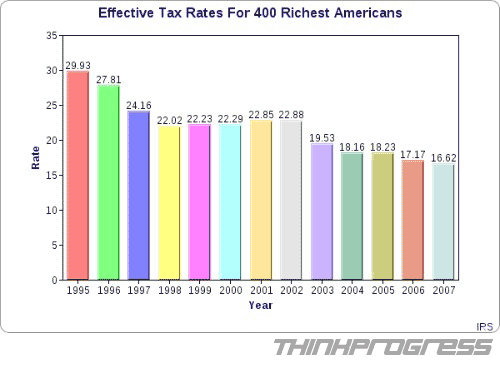
LOOK: Tax Rates & Income for 400 Richest Americans 1995-2007


Today is the last day one can file your tax return for 2010 (or request an extension until October 15, 2011).
As we think about taxes, it is instructive to see how the taxes and income of the 400 richest Americans have changed over the last two decades.

Hat/tip to Think Progress

Wednesday, April 13, 2011

LOOK: Defense Spending In Two Pictures


As the discussion about the federal government's budget intensifies, progressives are focusing attention on the defense budget.

Hat/tip to Think Progress

Saturday, April 9, 2011

AD-45: Luis Lopez Fundraiser TODAY in Silver Lake


My friend Luis Lopez is running to represent the 45th Assembly District (in which I live) that is being vacated when Gil Cedillo is termed out next year. Luis is an open;y gay Latino "homegrown progressive" and has strong labor bona fides as intrepid lesbian reporter Karen Ocamb details at LGBT POV.
Teachers, nurses, long-term care workers, community allies–the whole labor family–converged on First AME in Los Angeles on Monday, April 4, to rally together in support of Wisconsin workers and to show strength in numbers in California.
The environment was buzzing and filled with familiar faces–young and old–representing the rich diversity in race, ethnicity, immigration status, and language that are Los Angeles and California.
This rally’s message echoed the recent march downtown, where I added my voice with several thousand California voters and the sounds of protest chants and high-school bands. We spoke then and reiterated in church on Tuesday that California must not and will not become Wisconsin. In both states, community leaders and elected officials need to heed the public outcry and the economic evidence: collective bargaining, public education, affordable healthcare and higher education, and reliable pensions are the backbones of a strong middle class. These proven tools of America’s strength need to be upgraded and renewed, not undermined or reversed.
Luis has a fundraiser this afternoon at Le Barcito in Silver Lake. Please support him!

Thursday, March 10, 2011

Illinois Becomes 16th State To Abolish Death Penalty

Illinois abolished the death penalty this week when Democratic Governor Pat Quinn signed SB 3539 into law, which was passed by the state legislature in January. There are now 16 states (not even 1/3 of the Union) which do not have their ability to waste money to kill their own citizens, regardless of the criminal conviction.

The New York Times reported:
Dozens of family members of victims had signed a letter to the legislature supporting the bill, arguing that capital trials and appeals “drag victims’ loved ones through an agonizing and lengthy process, which often does not result in the intended punishment.”


The current and future mayors of Chicago took different sides, with Mayor Richard M. Daley supporting capital punishment, and Rahm Emanuel, who will became mayor this spring, saying the ban was the right thing to do.


Illinois joins a wave of states that have reconsidered capital punishment. New Jersey abolished the practice in 2007. The New Mexico Legislature ended the death penalty in 2009. New Mexico’s newly elected governor, Susana Martinez, a Republican, has asked the Legislature to reinstate it, though bills to do so have stalled. The Connecticut legislature voted to abolish the penalty last year, but the governor at the time, M. Jodi Rell, a Republican, vetoed the measure.
Governor Quinn issued a statement:
Since the General Assembly passed this bill, I have met or heard from a wide variety of people on both sides of the issue. I have talked with prosecutors, judges, elected officials, religious leaders from around the world, families of murder victims, people on death row who were exonerated and ordinary citizens who have taken the time to share their thoughts with me. Their experiences, words and opinions have made a tremendous impact on my thinking, and I thank everyone who reached out on this matter.


After their guidance, as well as much thought and reflection, I have concluded that our system of imposing the death penalty is inherently flawed. The evidence presented to me by former prosecutors and judges with decades of experience in the criminal justice system has convinced me that it is impossible to devise a system that is consistent, that is free of discrimination on the basis of race, geography or economic circumstance, and that always gets it right.


As a state, we cannot tolerate the executions of innocent people because such actions strike at the very legitimacy of a government. Since 1977, Illinois has seen 20 people exonerated from death row. Seven of those were exonerated since the moratorium was imposed in 2000. That is a record that should trouble us all. To say that this is unacceptable does not even begin to express the profound regret and shame we, as a society, must bear for these failures of justice.


Since our experience has shown that there is no way to design a perfect death penalty system, free from the numerous flaws that can lead to wrongful convictions or discriminatory treatment, I have concluded that the proper course of action is to abolish it. With our broken system, we cannot ensure justice is achieved in every case. For the same reason, I have also decided to commute the sentences of those currently on death row to natural life imprisonment, without the possibility of parole or release.


I have found no credible evidence that the death penalty has a deterrent effect on the crime of murder and that the enormous sums expended by the state in maintaining a death penalty system would be better spent on preventing crime and assisting victims’ families in overcoming their pain and grief.


To those who say that we must maintain a death penalty for the sake of the victims’ families, I say that it is impossible not to feel the pain of loss that all these families share or to understand the desire for retribution that many may hold. But, as I heard from family members who lost loved ones to murder, maintaining a flawed death penalty system will not bring back their loved ones, will not help them to heal and will not bring closure to their pain. Nothing can do that. We must instead devote our resources toward the prevention of crime and the needs of victims’ families, rather than spending more money to preserve a flawed system.

As a long-standing member of Amnesty International, I say "Congratulations!" to Illinois. Governor Quinn has now signed into law death penalty abolition and civil unions enactment. The state is becoming a more progressive by leaps and bounds.

Wednesday, March 9, 2011

GSS Shows Support Exceeds Opposition To Marriage Equality


University of Illinois Sociologist Darren Sherkat has crunched the numbers of the 2010 General Social Survey to reveal that for the first time, more Americans support marriage equality than oppose the idea.

Sherkat says on his blog:
For the first time, a legitimate scientific survey is showing very clearly that the proportion of Americans who agree or strongly agree that same sex marriage should be legal exceeds the proportion who either oppose or strongly oppose marital rights.  46% of Americans favor civil rights, while 40% oppose civil rights, and the remainder just can’t seem to decide. Of course, this is an incredible shift from the first time the question was asked in 1988–when 73% of Americans opposed marital rights, but it is also a seismic change from 2004, when only 30% of Americans supported marriage rights for same sex couples, and 56% opposed civil rights.
Sherkat has analyzed the differences in support of and opposition to marriage equality by a number of different identifying characteristics such as race, religion, political affiliation.

For example, Sherkat has written a paper debunking the "zombie meme" that Black people were responsible for Proposition 8's passage (and the subsequent implication that African-Americans are more homophobic than white people). He demonstrates he racial gap in opposition to marriage equality in the following graph:

The reason for the racial gap in opposition to marriage equality, Sherkat explains in "Race, Religion, and Opposition to Same-Sex Marriage," is primarily explained in the different rates of religiosity among Black Americans and white Americans. Even so, in the last 6 years since same-sex marriage has been a reality in Massachusetts and beyond, opposition in the Black community has fallen faster (17 percentage points) than opposition in the White community (15.4 percentage points).

Sherkat's most interesting result is in his analysis of how religious beliefs and partisan affiliation impact opposition to marriage equality .

As Sherkat (somewhat irreverently) explains:
Notice that among fundies, who believe the bible is the inerrant word of god, support is very low even if you are a strong Democrat–but it’s twice as high as it is among Republican fundies. Among moderates and seculars, the effect of political party is quite dramatic—67% of strong Democrats who think the Bible  was inspired by god support same sex marriage, while among Republicans with the same beliefs support is 18%. Among people who think the bible is bunk, 82% of strong democrats support same sex marriage, while only a third of republican non-believers support civil rights. Party matters.
I wonder what the Log Cabin Republicans have to say about these results?

Wednesday, February 23, 2011

Hawaii Governor Signs Civil Unions Bill Into Law


On Wednesday February 23 Hawaii Governor Neil Abercrombie signed Senate Bill 232 into law, making Hawaii the seventh state to legalize civil unions. The Democratic governor fulfilled a campaign promise and reversed a decision made by Republican Governor Linda Lingle one year ago. When Hawaii's civil unions law goes into effect on January 1, 2012 it will allow opposite-sex and same-sex couples access to all the rights, responsibilities and benefits of marriage that the state of Hawaii can provide them while not calling such unions marriages.

The Honolulu Star-Advertiser reported:
"E Komo Mai: It means all are welcome," Abercrombie said in remarks before signing the bill into law. "This signing today of this measure says to all of the world that they are welcome. That everyone is a brother or sister here in paradise." 
"The legalization of civil unions in Hawaii represents in my mind equal rights for all people," he said.
The other states that have civil unions (or comprehensive domestic partnership statutes) which provide all the state rights, responsibilities and benefits of marriage through a "separate but equal" legal status are:  California, Oregon, Washington, Nevada, New Jersey and Illinois. Only the last two of these states actually call their laws "civil unions." The laws in these states are open to opposite-sex and same-sex couples. Three other states, New Hampshire, Vermont and Connecticut previously had civil unions laws on the books which were superseded by the enactment of marriage equality in those states. The states with comprehensive domestic partnership laws generally limit eligibility to opposite-sex couples where one partner is above 62 and all adult same-sex couples.
 

FREE HOT NUDE YOUNG GIRLS | HOT GIRL GALERRY